Adeline Chapter Three: Spring Cleaning
The room was dim except for the thin bar of light above Nanna’s bed. Somewhere beside her, a machine hummed and clicked.
Beanie, are you here?
“I’m right here, Nanna.”
Are you writing this down? I don’t know that I’ll ever be able to remember it all again.
“I’m writing down every word you say, Nanna. I’m writing it on my heart so it will never be lost.”
You make me smile from the inside out, Beanie Girl. From the inside out.
Well now, the lower lake was a long, skinny body of water that curved back and forth like a snake. It was, of course, connected to the upper lake by the channel. Our cabin sat on the far side of the upper lake, and it was shaped like a bowl. The lake, that is, not the cabin. The cabin, well, I’ll get to that in a bit.
Now, the lower lake had a charm all its own, what with all the twisting and turning. But most importantly, the lower lake was the location of the famous rope swing and the diving cliffs.
A white wooden cross graced the hill above the cliffs as a reminder that someone had tragically died at some time in history jumping from those cliffs. If you think that was a reasonable warning for people like us, you are wrong. We jumped anyway.
Not only did we jump off the death-defying cliffs, but we also climbed up the trunk of an old fallen-down tree, hung on to a fraying, knotted-up old rope, and swung out over the water. We would let go with a scream just as we cleared the jutting rocks that threatened to break our bodies into pieces if we let go too soon.
It was the thrill of it all, you know, and even though we occasionally had a close call or two, it only seemed to sweeten the deal, if you can believe it. I guess you could say we were an adventurous sort, if not a little crazy.
Now, as I said, our cabin sat on the far side of the upper lake. The upper lake was preferable because of its shape. You were better off water skiing on the wide-open body of water, and it tended to be a lot calmer than the lower lake. Yet it was not without its share of interesting shoreline, coves, points, and even a freshwater mountain spring where we often filled our water jugs.
The upper lake was protected by surrounding mountains, mountains covered in towering evergreens and thick, heavy foliage. Pine and fir trees were everywhere, all kinds of berries grew, and wild roses blossomed all summer long. We had paradise, we did.
All I wanted to do that day was go back and revisit paradise.
Anyway, first I need to let you know how the cabin came to be. You see, with the babies coming along and business just getting started, Jack did what a father must do in order to build his family a summertime home.
He always said he’d never have his children wasting away in the city all summer long when they could be running wild at the lake. So he salvaged materials from demolition projects. Sometimes people would call him up and say, hey, if you want some doors or some paneling or whatever before the so-and-so building gets knocked down, go get it. And Jack would drop everything and run off ahead of the wrecking ball and take what he could.
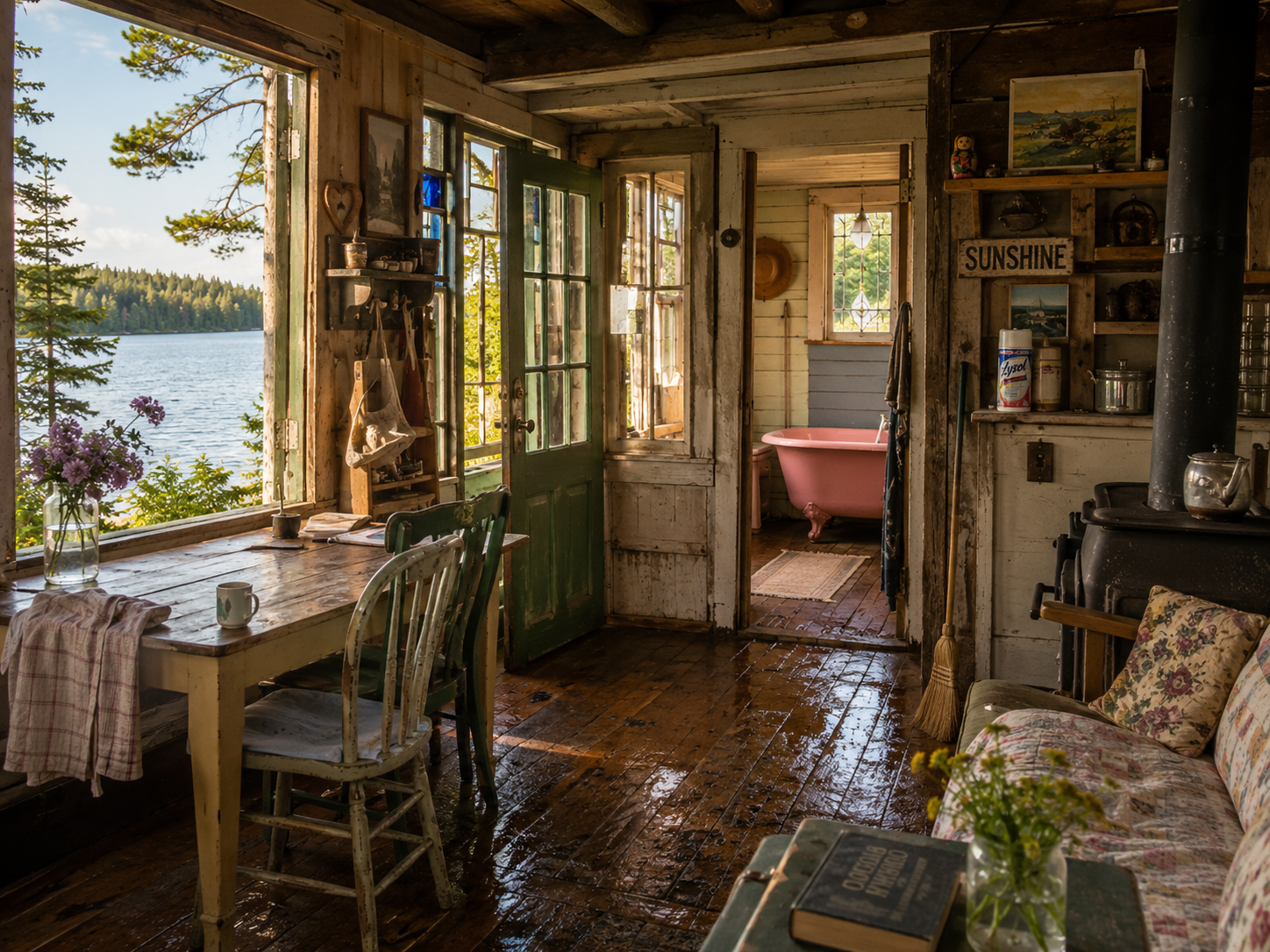
Consequently, each room in our cabin had its own unique style: different wallboards or paneling, different doors, different shapes and sizes. He would make adjustments and finagle the materials to fit together as best he could.
As you might imagine, we had perhaps a little better ventilation in that old cabin than was ideal.
And, oh my, the variety of windows! We had some amazing windows, some windows without any glass, some with cracked glass, and we even had a tiny stained-glass one.
Jack cut a hole in the wall at the end of the hallway and put it there so we could all enjoy the way the sun shone through the colors in the morning light, painting rainbows everywhere we looked.
In our bathroom, we had a very old-fashioned commode with a pull-chain flush that Jack rescued from an old hotel in the process of taking its last breath. I was proud to have it grace our quaint little bathroom, but I always worried about the weight of it and the chance of it falling through the floor. I’m not sure what Jack used for flooring, and I’m sure it’s best if I don’t ever know.
As a contrast, and for the sake of keeping things interesting, a very modern bright pink bathtub kept company with the commode. And, of course, there was a sink. Just a plain ol’ sink, nothing remarkable about it.
Now, the door never fit quite right, which caused all kinds of frustration, especially with the girls. Even though Jack tried to fix it here and there all the time, it never closed tight. There was always the feeling of exposure in that little bathroom.
The only good thing about that is nobody spent any unnecessary time in there. That was a blessing over the years, as there were nine of us altogether back then. Oh, Lord, that was a lot of people sharing one tiny little bathroom. I sometimes wonder how we did it.
“Tell me more, Nanna. Tell about the mice, and about the way the flooding always happened.”
Well now, Beanie Girl, the cabin, as you might imagine, was a sieve of a summer dwelling few folks would bother to construct. Although we didn’t intend to lay out the welcome mat for every rodent within a hundred-mile radius, apparently that’s just exactly what we did.
The mice spent the winters nice and cozy, nesting in the dresser drawers and between the springs of the old mattresses. Opening up the cabin for the season was always a day of mixed emotions: excitement for the onset of summer and dread for what surprises were waiting to be discovered.
More times than I can count, we’d uncover newborn mice, all pink and squeaky, in a nest of toilet paper scraps, squirming together for warmth.
I’d get Jack and the kids to haul the mattresses outside so we could beat them like old rugs. I’d have the boys get sticks and go at it, encouraging the unwelcome inhabitants of the stuffing to scurry out and run for their lives. The mattresses always smelled like mouse. We were either successful in getting rid of the smell or we just got used to it, I was never sure which.
But I’ll tell you one thing for sure, after a day of beating those old things around and airing them out in the warm sun, we’d happily drop our weary bones down to sleep on any one of them.
Next, I’d remove any dresser drawers the stinky trespassers had chosen as a nursery and dump the naked pink contents into the icy rushing waters of the neighboring creek. The creek normally overflowed with the heavy snowmelt coming from the mountain behind the cabin.
Although each spring the boys begrudgingly dug out a trench around the back of our humble structure, there was always flood damage that resulted in a thick layer of silt carpeting the cabin floor.
I’d get the boys to start by shoveling out as much as they could, scraping the big flat face of a snow shovel across the old wooden floor and out the front door. Then they’d use the sorry remains of an old push broom to remove what the shovel didn’t get. I’d finish off with two or three good moppings. By that time, we’d all agree it was good as new.
Next, we’d attempt to plump up the rock-hard sandbags edging the creek, adding a stack of rocks here and there, just in case there was a final overflow before the snow was completely melted high in the mountains.
These things together would hopefully save us from having to do the floor a second time. It usually worked, but sometimes it didn’t.
There were always unexpected surprises to deal with, too. Once there was a dead bobcat rotting away under the porch and smelling so bad we didn’t know if we’d ever get rid of that stench.
Occasionally, there would be a dead bat hanging around somewhere, usually off the fabric cover of a front-room chair or maybe off the draperies. At least they were dead.
Spiders, dead and alive, inhabited every possible nook and cranny and, for some reason, the bathtub by the dozens. Not understanding what the attraction was, we reasoned that the live ones spent their time in there surviving off the dead ones.
Our cabin had many charming features, my favorite being the fact that some of the windows actually had glass in them and some did not. The glass ones had to be cleaned, of course, but the empty ones just had shutters to be removed. When that was done, you could see crystal clear all the way to the end of the lake.
The shutters didn’t open and close properly, so it was just easier to remove them completely and then nail them back up in the fall. We saved the removal job for the middle of June, though, knowing the weather would most likely cooperate after then.
Our spring cleaning was always topped off by using the entire contents of a can of Lysol Disinfectant Spray. The idea was that we’d leave our summer home not only de-moused, de-bugged, and de-mudded, but disinfected, too. Eventually, we’d have the place looking and smelling livable, and we’d drive away trusting we’d return the next weekend to things just as we’d left them.
A pipe dream, of course.
Oh my, I miss those times.
“Mrs. Cornell? Mrs. Cornell, wake up. You need to take your medicines.”
Why am I still here? I thought I’d be home the next time I woke up.
“Well, you’re not quite ready to go home. Hopefully, you will be in a few more days.”
Did my granddaughter leave? I don’t remember her saying goodbye.
“I’m sorry, I didn’t see anyone here. There, you try and get a little more sleep, alright? You’ve been awfully restless.”
Adeline continues next week with Chapter Four.